Posts

Navigating Human Emotions with the “Social Compass”
Image
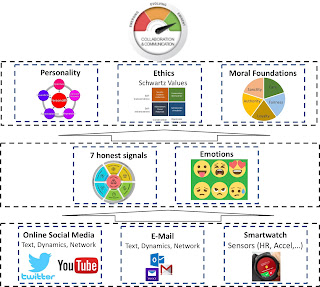
Navigating human emotions can be extremely difficult. Just ask politicians such as former US Vice President Joe Biden who was hit by a firestorm of protests by getting too touchy-feely with supporters, or US senator Elizabeth Warren who ran into unexpected criticism for claiming Native American ancestry. While trying to behave rationally, they become victims of their emotions. In an interview Linus Torvalds said “I absolutely detest modern "social media"—Twitter, Facebook, Instagram. It's a disease. It seems to encourage bad behavior.”…. “When you're not talking to somebody face to face, and you miss all the normal social cues, it's easy to miss humor and sarcasm”…”The whole "liking" and "sharing" model is just garbage. “ In our research we are developing a “Social Compass” that helps individuals navigate their emotional world, just like Google helps a person to navigate the relational world of facts and science. Just like Google Maps shows...

Why money matters most in the US, being happy in the rest of the World!

Image
It seems there is a digital divide of a special kind between the US and the rest of the World. Using Google ngrams and Google trends as my cristal ball, I checked what people are searching most. First I looked at their "hope", "fear", "love" and "money" over the last 200 years on ngrams worldwide. The result is shown below. "Hope" has been decreasing for the last 200 years, as has "fear", which makes sense, they go together and most of the time “we hope it is not as bad as we fear”. More interesting is the decrease in our search for "love", and increase in the search for "money", reaching its peak in the 1940s, tampering off since then, while "love" has been picking up recently. Drilling down on the last fifteen years, Google trends shows that while "love" matters more than "money" (after all money is just a proxy to buy love), happiness and money are close twins: ...

Highly Intelligent Is Not Highly Creative – How to Be Truly Innovative

Image
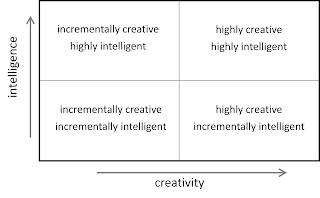
In research as well as in entrepreneurship, there are many characteristics distinguishing an exceptional researcher or entrepreneur from just a good one. In particular there is a key difference between highly intelligent and highly creative people, as these characteristics are not necessarily correlated. Intelligence is commonly defined as the ability to acquire and apply existing knowledge and skills, while creativity is the ability for something novel and valuable. New research and new enterprises can therefore be grouped into four categories: Highly intelligent, incrementally creative researchers or entrepreneurs add an incremental twist to existing methods and knowledge. For instance, a researcher might add mathematical bells and whistles to widely accepted ideas and concepts - in Renaissance Europe they might have added an additional proof that Earth was indeed flat and that the Sun was circling around it. Most of the papers in Nature and Science fall into this category, ce...

Principles of Profiling Users with AI

Two days ago I read a Washington Post article about 3 Californian AI startups that profile users based on opaque AI algorithms. Their products calculate a quality score for people in different domains without explaining how it is calculated Predictim.com calculates a “risk rating” of babysitters based on their social media activities. HireVue analyzes tone, word choice, and facial movement of job candidates to predict their skill on the job. Fama does employee screening on social media and internal HR data to prevent what they call “brand risk” such as sexual harassment, bullying, or insider threats of employees.  The main problem with these and similar systems is that they use machine learning, in particular deep learning as a black box. Their algorithm gives back a score claiming high numerical accuracy without explaining how it has been calculated. Our own Condor software is doing similar things, showing a bird’s eye view of the communication patterns of organizations...

Why Donald Trump is No Leader

There are many ways to identify exemplary leaders. One of my preferred categorizations comes from here . It lists humility, curiosity, and empathy as the main criteria of successful leadership. I am afraid that on all three criteria Donald Trump scores zero: Humility  means that exemplary leaders treat everybody with respect, are not afraid of criticism and are willing to admit their own mistakes. They are willing to put their own ego into the background for the sake of others. Donald Trump stands for the opposite, as an egomaniac person who is obsessed with his own power and glory. Curiosity  means that a leader is constantly looking to further his own understanding, is willing to defer to the knowledge of others, and thirsty for new information. One of the first actions of Donald Trump was to cut funding in research, denying scientific facts about vaccination  and climate change , showing zero scientific curiosity. Empathy means that we treat others with compa...

What Emails Reveal About Your Performance At Work

Recently HR analyst Josh Bersin interviewe d Praful Tickoo , head of HR analytics, and Piyush Mehta, CHRO at Genpact, about the work we have been doing together for the last 5 years to identify both rock stars and flight risk of employees. His excellent blog post is here .

Did Cambridge Analytica’s Facebook Harvesting Decide the US Elections?

Have the Russians and Cambridge Analytica been abusing Facebook to influence the US and British elections by spreading fake news to receptive users? Absolutely Yes! Has this abuse had an impact on the US elections and Brexit? Most likely not! It becomes increasingly clear that people like Donald Trump (through his former confidant Steve Bannon) and Vladimir Putin have been (illegally) harvesting user profiles on Facebook and setting up Twitter bots to spread fakenews on Facebook and Twitter . Facebook by its own account admitted that fake news produced by the Russians and US Alt-right proponents might have been seen by millions of users. What has not been shown, however, is what effect this has had on the actual voting behavior. I argue that this effect has been minimal, most likely smaller than the voting margin for Trump in the US elections, and for Brexit in the UK. While a group of researchers has done an t horough analysis of the dynamics of the spread of ...