Posts

Predicting the results of today's Swiss vote on freedom of movement and residence
Image
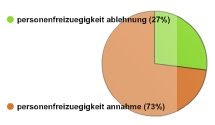
Today the Swiss voted about extension of the right of free movement and residence with the rest of the European Union. The vote was brought by the extension of the right of free movement and residence (Personenfreizügigkeit) to new EC member states Rumania and Bulgaria, which had previously been approved by the Swiss government. The right-wing people's party collected enough votes against it to ask for a referendum. The vote was today, and according to early polls it started looking good for the supporters of the right of freedom and movement. I wanted to know what the Web and Blog would predict, and here are the Coolhunting results: on the Web: Yes (Personenfreizügigkeit Annahme) 73% No (Personenfreizügigkeit Ablehnung) 27% on the Blogs: Yes (Personenfreizügigkeit Annahme) 58% No (Personenfreizügigkeit Ablehnung) 42% By now (Feb 8, 4 pm), the final results are here, and the right on freedom on movement and residence (Personenfreizügigkeit) has been approved by the Swiss voters wit...

How to make Washington cool - followup

Recently (see my previous blog post) I was interviewed by a journalist from the Washington Post about how cool Washington is. Her conclusion was that DC is not cool. This led to a backlash of negative reactions - I got my share of it also, see the post here and the comments on the original story. I would like to point out there are very cool places in Washingon. There is for example the hotel I stayed in one of my last trips to DC, the Tabard Inn , a very cool boutique hotel. But there are also less cool things in DC, like when I was scheduled to give a presentation on Collaborative Innovation at the World Bank, and was not let in for 45 minutes because security was so tight they could not find anybody with the right credentials to identify me. But actually it would be quite easy to make Washington very cool. Cool places are made by cool people, and one of them just started in his new job last week. It’s now up to all of us to get more of the same to Washington!

How to make things and places “cool”?

Yesterday the Washington Post published a timely opinion piece on “how to make D.C. cool” , pondering the question whether Washington D.C. could ever be cool. The journalist had interviewed me for this article, and the discussion with her got me thinking about what it takes to make a place “cool”. Why is it that NYC, SF, or Boston are cool, while D.C, a popular tourist destination, seems in dire want of coolness? Let’s first look at what makes things cool. “Cool” things have four properties. First, they need to be fresh and new , we don’t want yesterday’s stale old ideas, but radically new and better ones. Apple is cool, Microsoft is not. Why? By ushering in a new era in computers with the Macintosh, in music players with the iPod, or in mobile phones with the iPhone, Apple has shown a unique knack in coming up with beautiful new things. Microsoft may be more profitable, and having grown to much bigger size with its copycat strategy, but nobody has ever accused it of being cool – tha...

Who will be the next "Stadtpraesident" (mayor) of Zurich?

Image
There is a hot race currently between the two ladies Kathrin Martelli and Corinne Mauch for the succession of the popular mayor of Zurich, Elmar Ledergerber, who stepped back recently. I was curious to see what Web and Blog have to say about the chances of the two candidates. Here is the Coolhunting result of Condor for today on the Blog (Jan 8th, 2009) - Corinne Mauch leads with 53% Repeating the same process on the Web, to get the more long term trend, leads to the same result - it looks even worse for Kathrin Martelli who gets only 35% of the Coolhunting vote. We will know Feb 8, after the election. The only thing certain: Zurich's next mayor will be female.

Analyzing film scripts with condor

Image
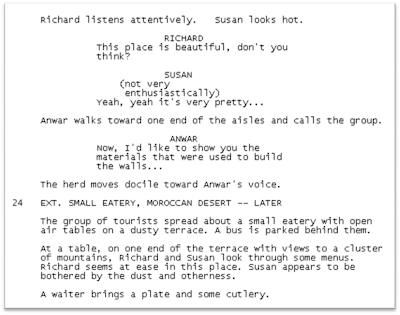
While participating this winter in a seminar on Social Network Analysis and COINs (Collaborative Innovation Networks) by Peter Gloor and Kai Fischbach at the University of Cologne, it occurred to me that a film script provides a great source for Social Network Analysis. Each character in a movie receives and sends messages through dialogues with other characters. These are represented as edges in Condor - the social network tool we are using in this seminar. As the film script only allocates the sender of each dialogue, one has to manually add one or more receivers. A timestamp for each conversation can be created by looking at the scene in which the conversation is initiated. As you can see in the picture above, the film industry has very strict rules on the layout of a film script. So once one writes a parser for one script, it will work for almost every other script too. There are a few good sources like awesomefilm.com , imsdb.com or simplyscripts.com where you can find film scr...

Register for CoolPeople Beta

Image
We have now opened registration for our cool new CoolPeople application . CoolPeople finds influencers, trendsetters, and creators, and even measures their success. This can be done for example for "nanotechnology entrepreneurs in India", but also for "John Smith". It even finds the attributes of the people related to "John Smith". The picture below shows the CoolPeople network about the topic "Swarm Creativity" as a cybermap social network picture. The next picture shows the CoolPeople list view of the CoolPeople query "US President" If you want to see even more before pre-registering, try a dynamic preview: click on the "Condor" picture here which will bring up a dynamic cybermap about "swarm creativity".

Bankers are all Mad(off) – it’s communities we trust!

There are two articles in today’s NYT which resume where we stand regarding trust in ourselves, society, and our future. The first one is by NYT columnist Paul Krugmann, who talks about the Madoff economy. While everybody deplores the criminal tactics of Bernie Madoff, who, in the biggest Ponzi scheme of all times, squandered 50 billion dollars of investor money coming from anywhere on earth, Krugman makes the point that the rest of the Wallstreet bankers is not much better than Madoff. All of them got outrageously rich through outsized bonuses collected on trades in high-yielding, but highly risky assets. As the smoke at Wallstreet is slowly clearing, the bankers are keeping their bonuses, while the investors' money is gone. While Mr. Madoff skipped a few steps, simply stealing his customers’ money while passing on some of it to his earlier investors, the other bankers collected huge fees while exposing investors to risks they did not understand. The incomes of these employees i...