Posts

Showing posts with the label coolfarming

Using People Analytics for Analyzing “People Analytics” Thought Leaders

Image
Increasing workplace satisfaction and recognizing employee burnout before it happens are core issues in today’s Covid-19 home office workplace. People analytics has become a key technology to support these goals, thanks to recent progress in AI, machine learning, and other computer technologies. Using our own people analytics tools we analyzed the virtual tribe of key people working in the area of people analytics. If anything, this analysis shows that people analytics has become even more central in the Covid-world.  Using our Galaxyscope Tribefinder tool we created a virtual tribe of 57 Thought Leaders in the space of HR analytics, people analytics, and corporate culture. The picture below shows the social network of the people analytics thought leaders based on their Twitter network. Thought leaders are connected through who is retweeting and mentioning whom. It also categorizes each thought leader into an “alternative reality” tribe, identifying if somebody is a fatherlander, ...

To Be a Better Manager Means Not to Be a Manager!

Image
I think that time has come to fundamentally rethink the way we train and reward managers. While social entrepreneurship has become a popular buzzword at management schools, and Andrew Cuomo, the new governor of the state of New York asked all his senior staff to take an ethics class in the first sixty days of his tenure, this is still just lip service. My proposal is far more radical: Make managers redundant! Let me explain what I mean. 4 Motivational Phenotypes of Knowledge Workers When trying to understand the behavior and motivation of knowledge workers, it helps to group them into four phenotypes. These four types of knowledge workers, vastly differing in skill set and motivation, are: (1) the artists, (2) the scientists, (3) the teachers, and (4) the managers. Artists want to create something new and beautiful, to touch the lives of people interacting with their art. Whether it is painters, sculptors, actors, singers, or orchestra musicians, they do what they do mostly not becau...

My new Coolfarming Book out

Image
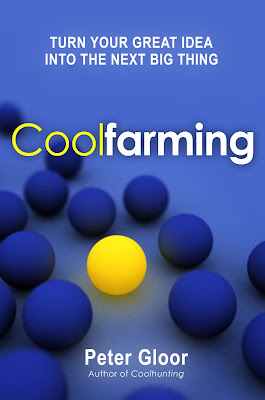
I am delighted to announce that – finally - my new book "Coolfarming - Turn Your Idea Into The Next Big Thing" just came out. “Coolfarming” is about how to grow your own trends by creating an environment where COINs (Collaborative Innovation Networks) flourish; then - once a product has become established - extend the creative pool into a Collaborative Learning Network, or CLN, whereby a targeted group of interested people are brought in to learn the basics of the product, make suggestions for improvements, point out deficiencies, and push the idea forward. When this feedback gets incorporated, things get really interesting, expanding the process further outward to a Collaborative Interest Network (CIN) that encompasses thousands or even millions of users, building what hopefully turns into a loyal fan base…and virtually guaranteeing the success of the idea. Based on case studies and examples from Linux to the Twilight series, from Procter & Gamble to Apple, this book let...

What Motivates Creators – Lessons from a Cool Artist

Image
Little did I know when I was attending one of the evening events of Swissnex that I was about to meet a truly impressive creator. After filling a heaped plate of food at the sumptuous buffet after the talks, I was looking for a place to eat when I noticed two attractive women in the back of the room. As soon as we started talking I noticed that they were not just a pleasure to look at and talk with but real creators. In my discussion with Magdalena, she told me that she was a graphic artist producing digital art . When she invited me to visit her in her studio I jumped at the opportunity. On a sunny afternoon the next week I climbed the stairs to her studio in Revere outside of Boston. The studio doubles as a gallery, displaying really cool art. When we sat on her couch in the middle of art books and framed digital pictures, Magdalena told me a bit about her life. She was born in Poland to parents of German descent, as a young adult she moved to Germany, later after she had married a...

Scientists, Monks and Bankers - It's All About Love

Why do people collaboratively engage in innovative tasks? What’s the motivation to work together to develop something new? After all, if I do everything by myself, I will reap all the rewards for myself, and don’t have to share. Nevertheless, humans are the most social species of all, and progress is only possible by collectively creating new things “standing on the shoulders of giants”, by learning from what others have done, and apply it in novel ways. According to my colleagues at the MIT Center for Collective Intelligence Tom Malone , Rob Laubacher , and Chris Dellarocas there are three main reasons why people engage in collective intelligence systems: Money – financial gain is a strong motivator for people participating in markets and traditional organizations, either for direct payment, or for future payment, e.g. acquiring new skills. Glory – getting recognition and building up a reputation can be an important motivator. Love – love can be an important motivator, be it beca...

Creating iPhone Apps - the Swarm takes over

Today's NYT describes a list of computer programmers turned entrepreneurs, creating cool apps for the iPhone. With the barriers to entry as low as they are here: one basically just needs a computer to download the app developer kit, plus of course programmer skills, this is the perfect opportunity for swarm business. People like Ethan Nicholas, a (former) Java developer at Sun, making $800,000 with a shooter game, are the new members of the swarm. Apple, handling sales and marketing including money collection though its App store, proves once more superb coolfarming skills.

How to make Washington cool - followup

Recently (see my previous blog post) I was interviewed by a journalist from the Washington Post about how cool Washington is. Her conclusion was that DC is not cool. This led to a backlash of negative reactions - I got my share of it also, see the post here and the comments on the original story. I would like to point out there are very cool places in Washingon. There is for example the hotel I stayed in one of my last trips to DC, the Tabard Inn , a very cool boutique hotel. But there are also less cool things in DC, like when I was scheduled to give a presentation on Collaborative Innovation at the World Bank, and was not let in for 45 minutes because security was so tight they could not find anybody with the right credentials to identify me. But actually it would be quite easy to make Washington very cool. Cool places are made by cool people, and one of them just started in his new job last week. It’s now up to all of us to get more of the same to Washington!

How to make things and places “cool”?

Yesterday the Washington Post published a timely opinion piece on “how to make D.C. cool” , pondering the question whether Washington D.C. could ever be cool. The journalist had interviewed me for this article, and the discussion with her got me thinking about what it takes to make a place “cool”. Why is it that NYC, SF, or Boston are cool, while D.C, a popular tourist destination, seems in dire want of coolness? Let’s first look at what makes things cool. “Cool” things have four properties. First, they need to be fresh and new , we don’t want yesterday’s stale old ideas, but radically new and better ones. Apple is cool, Microsoft is not. Why? By ushering in a new era in computers with the Macintosh, in music players with the iPod, or in mobile phones with the iPhone, Apple has shown a unique knack in coming up with beautiful new things. Microsoft may be more profitable, and having grown to much bigger size with its copycat strategy, but nobody has ever accused it of being cool – tha...

Coolhunt #2: April 17, 2007

Image
Coolhunt Log #2 Tuesday, April 17, 2007 On Stage: Peter Gloor , MIT researcher with the Sloan School of Management, co-author of Coolhunting Scott Cooper, MIT researcher with the Sloan School of Management, co-author of Coolhunting Steve O'Keefe , moderator Leading the Coolhunt today is Scott Cooper. SCOTT: I'm connecting from my home office in Massachusetts. I've just been working on a project involving using RFID tags on buildings to help guide tourists through European cities. The technology lets citizens decide what attractions people should see--not some agency. MODERATOR: Scott, we look forward to a discussion of RFID tags at a future coolhunt . I'd like to update folks on the finishing work on yesterday's hunt. MODERATOR: We posted the log, then we sent emails to six business and technology reporters at The New York Times to let them know we coolhunted the NYT Online and discussed their "most popular" box. We received a personal email back fr...

Coolhunting and Coolfarming at Costco

While shoppers might go to buy a jumbo pack of toilet paper and laundry detergent at Costco, the world’s largest wholesale retailer, they are more likely to also walk out with a pair of fashion jeans, an iPod, or a large plasma TV – in addition to the toilet paper and laundry detergent. While a Wal-Mart stocks 100,000 items, a Costco makes 58 billion of annual revenue with just 4,000 items. It has become a terrific coolhunter, enticing its shoppers who came for daily necessities to also walk away with the latest and coolest gadgets, usually spending a couple of hundred dollars at every shopping expedition. According to its own words, Costco is “..trying to figure out what customers really want.” For that Costco only stocks the most well-liked, trendy, and fast-moving items. It also gets it known that each of its items which is usually offered at a very attractive price is only available in very limited supply. This way, Costco combines its coolhunting efforts for the trendiest products...