Posts

Latest News Through Wikipedia - Wikipedians are the real Citizen Journalists

Image
People have long predicted the demise of traditional news media and the rise of the citizen journalists. Various initiatives have tried to create new media outlets on the Web, Blog, and Twitter powered by creative swarms of hobby journalists - but none of them has been a breakthrough success so far. Well, it turns out that there is such a citizen Web site, venerable old Wikipedia! In a series of earlier projects we have analyzed collaboration among Wikipedia authors when creating new Wikipedia articles, for example studying how they collaborate as COINs in different cultures (http://www.ickn.org/documents/COINS2010_Nemoto_Gloor.pdf). In our current project we are creating a map based on Who-works-with-whom-on-Wikipedia (the "W5-map"). We build a semantic network of concepts by constructing a link between two Wikipedia articles if the same author has worked on both articles. This W5-map shows us to what kind of articles the swarm flocks to. By repeating this pr...

How Much Are People Smiling in the US, Germany, and Switzerland?

Image
Who are happier, people in Switzerland, in Germany, or in the US? To answer this question, I looked at the use of smiley’s in Twitter tweets – smileys are those emoticons used to express one’s emotions like :) smile :D big grin :( sad, frown :P sticking the tongue out, “raspberry” My hypothesis is that the larger the fraction of happy smileys :) and :D in all tweets containing emoticons is, the happier people in this region are. Using Condor’s Twitter collector, I collected 24 hours worth of tweets containing the smileys listed above in 6 cities in three countries: New York and Los Angeles (USA), Berlin and Hamburg (Germany) and Zurich and Berne (Switzerland). I collected all tweets inside a radius of 25 kilometers around the geocoordinates of these 6 cities returned by Google. The table below lists the results, showing the number of people using each emoticon in each city, as well as the betweenness centrality of the emoticon in the social network of people using it. As we can se...

Another Day of Hope (mostly), and some Fear and Worry in the US

Image
Today I checked on the mood of the US Population through Twitter, using Twitter’s Geotagging feature. Alan Mislove from Northeastern had already found that the mood of the nation changes over the course of the day, with people having a low over lunch, and getting collectively happier in the evening, when work is over. Using our Twitter-collector-tool built into Condor , I was able to easily replicate this result. I counted the number of retweets about “hope”, “fear”, and “worry” in the major population centers of the US, by collecting the tweets at four 2000 kilometers circles with centers at Pittburgh (North East), Atlanta (South East) Las Vegas (South West), and Boise (North West). (see picture below) I then constructed the social network between the retweeters as described in a previous blog post . The way it is calculated, it also factors in the importance of the retweeters, where a link is drawn between two people if a person retweets a post from the other person. The picture abo...

Monitoring Midterm Election Night Through Twitter Buzz

Image
Yesterday November 2nd 2010 was midterm election day in the US. I was curious what Twitter would tell us about the mood of the voters. It was already clear that things did not look good for the Democrats. In prior work analyzing data from 2009 we had already found that monitoring posts for the occurrence of “hope”, “happy”, “fear”, and “worry” would give us a good proxy for the mood of the population, particularly if we focused on the retweeted posts. So this time I repeatedly ran our Twitter data collector in 30 minute intervals, each time collecting the 200 most retweeted Tweets containing either hope, happy, fear, or worry. The picture below shows all tweets, with the red dots depicting the tweets containing more than one of the search words. Measuring the betweenness value (i.e. the importance of the search term) shows that popular tweeters prefer tweeting about “happy” (32%) and “hope” (30%) over the “worry” (19%) and “fear” (19%) tweets. Note that I collected precisely the sam...

Emotions Draw Close Friends: Analyzing the Social Network Structure of Facebook Fan Pages

Image
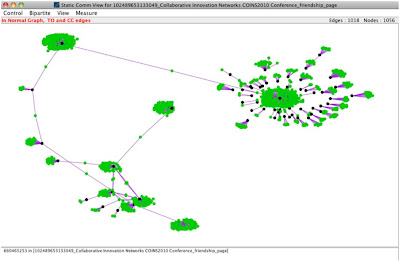
Recently we were wondering if the social network structure of fans of a brand, a star, or a cause tells us how passionate the fans are. To be more precise, we were looking at the network structure of the friendship network of Facebook fan pages. This means that we collected – as far a publicly accessible – the friendship network of the people who clicked on the “like” button on a fan page. For a start, look at the fan page of our own COINs2010 conference (by the way, the conference will be soon in Savannah Oct 7 to 9, at SCAD, we hope to see many of you there ☺ ). The dark dots in the network are the fans of COINs2010, the green dots are their friends. This means that for this initial analysis we looked at how many and how well-connected friends a fan of COINs2010 has. We ignored direct links between the fans, but focused on their external friendship network. In this first attempt we looked at a total of 15 fan groups in 5 categories, see the table below: We (admittedly subjectively...

Predicting Stock Market Indicators Through Twitter “I hope it is not as bad as I fear”

Image
We have been working on trying to predict market indicators for quite some time by analyzing Web Buzz , predicting who will win an Oscar, or how well movies do at the box office . Among other things we have correlated posts about a stock on Yahoo Finance and Motley’s Fool with the actual stock price, predicting the closing price of the stock on the next day based on what people say today on Yahoo Finance, on the Web and Blogs about a stock title. The rising popularity of twitter gives us a new great way of capturing the collective mind up to the last minute. In our current project we analyze the positive and negative mood of the masses on twitter, comparing it with broad stock market indices such as Dow Jones, S&P 500, and NASDAQ. We collected the twitter feeds from one whitelisted IP for six months from March 30, 2009 to Sept 4, 2009, ranging from 5680 to 42820 tweets per day. According to twitter this corresponds to a randomized subsample of about one hundredth of the full volum...

My new Coolfarming Book out

Image
I am delighted to announce that – finally - my new book "Coolfarming - Turn Your Idea Into The Next Big Thing" just came out. “Coolfarming” is about how to grow your own trends by creating an environment where COINs (Collaborative Innovation Networks) flourish; then - once a product has become established - extend the creative pool into a Collaborative Learning Network, or CLN, whereby a targeted group of interested people are brought in to learn the basics of the product, make suggestions for improvements, point out deficiencies, and push the idea forward. When this feedback gets incorporated, things get really interesting, expanding the process further outward to a Collaborative Interest Network (CIN) that encompasses thousands or even millions of users, building what hopefully turns into a loyal fan base…and virtually guaranteeing the success of the idea. Based on case studies and examples from Linux to the Twilight series, from Procter & Gamble to Apple, this book let...